

Rolex Oyster Perpetual
Strip away everything unnecessary and what remains is essential. That's the Oyster Perpetual. No date complication. No second time zone. No chronograph. Just the three things Rolex perfected decades ago: the waterproof Oyster case, the self-winding Perpetual movement, and a clean dial with perfe...
See moreStrip away everything unnecessary and what remains is essential. That's the Oyster Perpetual. No date complication. No second time zone. No chronograph. Just the three things Rolex perfected decades ago: the waterproof Oyster case, the self-winding Perpetual movement, and a clean dial with perfect legibility. This is Rolex at its most pure, most fundamental, most honest. Everything else in the catalog adds features to this foundation. The Oyster Perpetual is the foundation.
For years, the Oyster Perpetual quietly existed as Rolex's entry point, the watch you bought before you could afford the Datejust or Submariner. Then in 2020, Rolex did something unexpected: they released the Oyster Perpetual in a range of vibrant colors turquoise, yellow, coral, green, candy pink. Suddenly this understated watch became the hardest Rolex to find. Waiting lists formed. The secondary market went wild. People realized that sometimes what you want isn't complications or status symbols. Sometimes you just want a perfectly made watch in a color that makes you smile every time you check the time.
At Konesseur, we've selected Oyster Perpetual watches in various sizes and dial colors. Available from 28mm to 41mm, each offers pure Rolex quality without the premium attached to more complicated models. Explore our collection below.
Sort by
What the Oyster Perpetual Represents
The Oyster Perpetual isn't named after a specific function or achievement like other Rolex models. The name describes what it is: Oyster refers to the waterproof case Rolex patented in 1926, and Perpetual refers to the self-winding automatic movement they perfected in 1931. Put them together and you have the foundation of every modern Rolex. The Submariner is an Oyster Perpetual that can dive. The Datejust is an Oyster Perpetual with a date. The Daytona is an Oyster Perpetual with a chronograph. But the Oyster Perpetual itself remains unchanged, unadorned, exactly what Rolex intended nearly a century ago.
This simplicity is why the Oyster Perpetual resonates now more than ever. In a world where watches compete with complications and gimmicks, where brands stack features to justify prices, the Oyster Perpetual simply is. It doesn't need to prove anything. The movement inside has decades of development behind it. The case design has survived nearly 100 years unchanged because it was right the first time. The absence of a date window means the dial stays symmetrical, balanced, pure. Nothing on this watch exists to impress anyone. Everything exists because it should.
The 2020 Color Revolution
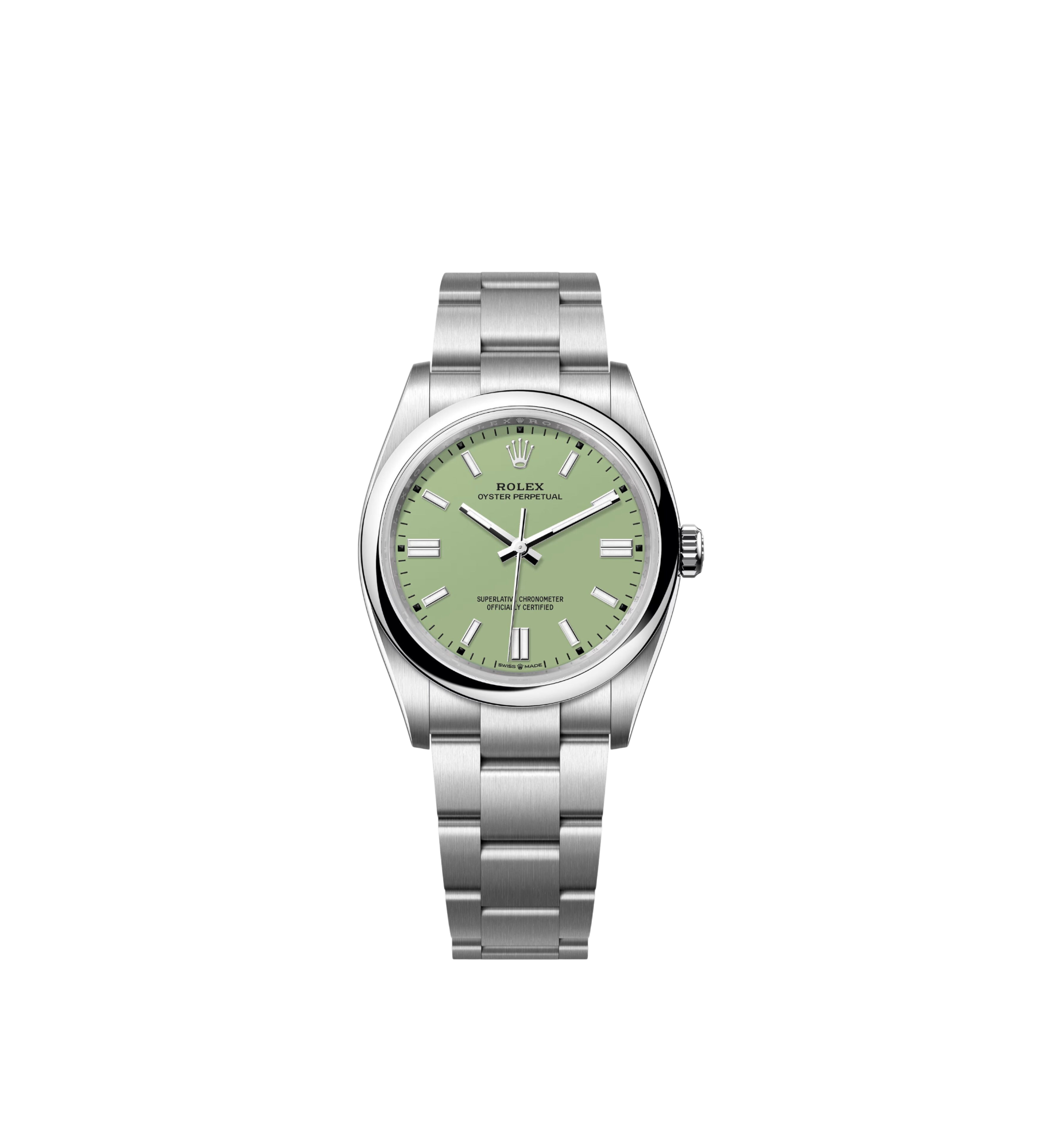
For most of its existence, the Oyster Perpetual came in safe colors: black, white, silver, maybe blue. Conservative. Sensible. Forgettable. Then in September 2020, Rolex released five vibrant new dial colors: turquoise blue (Tiffany blue, though Rolex would never call it that), coral red, yellow, candy pink, and green. These weren't subtle variations. These were bold, saturated, joyful colors on a watch that had spent decades being serious.
The reaction was immediate. The turquoise dial especially became impossible to find. Authorized dealers had waiting lists stretching years. The secondary market exploded with people paying double or triple retail. Why? Because these colors represent something Rolex rarely does: pure fun. No professional justification. No heritage story. Just watches in colors people actually wanted to wear. The turquoise Oyster Perpetual became the watch of 2020-2021, more hyped than sports models, harder to get than a steel Daytona in some markets.
That hype has cooled slightly, but the colors remain popular. Rolex proved that people don't always want serious tool watches or status symbols. Sometimes they want a well-made watch in a color that sparks joy. The Oyster Perpetual delivers exactly that.
Understanding the Sizes
Oyster Perpetual 28mm
The smallest current Oyster Perpetual at 28mm is often marketed toward women, but plenty of people of all genders wear it. If you have a smaller wrist (under 6.5 inches) or simply prefer vintage proportions, 28mm wears beautifully. It's delicate without being fragile, present without dominating. The 28mm comes in the full color range including the vibrant dials, which look particularly good at this size the smaller dial concentrates the color, making it more impactful.
Oyster Perpetual 31mm
The 31mm bridges the gap between clearly small (28mm) and clearly unisex (36mm). It works particularly well for wrists in the 6.5 to 7 inch range. The 31mm Oyster Perpetual offers the same dial options as larger sizes but in more classic proportions. This size has historical precedent many vintage Rolex sport watches were 34-36mm, so 31mm isn't "small" in the historical context, just smaller than modern trends.
Oyster Perpetual 36mm
The 36mm is the classic Rolex size, the dimension that defined men's watches for generations. It's the same diameter as the standard Datejust, proven over decades to work on nearly every wrist. The 36mm Oyster Perpetual is genuinely unisex equally popular with men and women, equally appropriate for formal or casual wear. If you're unsure which size to choose and your wrist is average (6.5 to 7.5 inches), start here. The 36mm especially suits the vibrant dial colors, offering enough space for the color to breathe while remaining tastefully proportioned.
Oyster Perpetual 41mm
The largest Oyster Perpetual at 41mm suits modern preferences for bigger watches. It's the same size as the current Submariner and Datejust 41, so if you wear those comfortably, the 41mm Oyster Perpetual will feel familiar. The larger dial provides more canvas for the color dials, though some argue the vibrant colors work better on smaller sizes where they're more concentrated. The 41mm works best for wrists 7.5 inches and up, or for anyone who's accustomed to contemporary watch sizing and finds 36mm too small.
Dial Colors and What They Say
Classic Dials: Black, Silver, Blue
The traditional Oyster Perpetual dials remain available and remain excellent choices. Black offers maximum versatility works with any outfit, any occasion, never feels wrong. Silver (often called white or bright dial) provides clean elegance, particularly good for formal wear. The standard blue (not the vibrant turquoise) gives personality without being loud, professional enough for conservative environments while adding character.
These classic colors also make practical sense if this is your only watch or primary everyday watch. Black and silver work everywhere, literally everywhere. You'll never look at your wrist and wish you'd chosen something more subtle. The trade-off is that these dials don't spark conversation or turn heads. They're excellent, just not exciting.
Vibrant Dials: Turquoise, Coral, Yellow, Pink, Green
The vibrant dials are what transformed the Oyster Perpetual from entry-level Rolex to must-have piece. Turquoise (sometimes called Tiffany blue, though that's not official) became the most sought-after, representing everything people loved about these releases: unexpected, beautiful, joyful. Coral red works surprisingly well as an everyday color bright without being fluorescent, warm without being aggressive. Yellow is the boldest choice, impossible to ignore, perfect for people who want their watch to be a statement. Candy pink divides opinion but looks incredible on the right person, particularly in smaller sizes. Green offers a middle ground distinctive but not shocking, sophisticated but not boring.
The risk with vibrant dials is fashion fatigue. Will you still love that turquoise dial in five years? Ten years? There's no wrong answer, but it's worth considering. These colors make people happy now. Whether they'll make you happy long-term depends on your relationship with color and trends. Some people wear the same vibrant dial daily for years and never tire of it. Others buy it, enjoy it for a season, then wish they'd gone classic.
What You Give Up (And What You Gain)
The Oyster Perpetual saves money by omitting features. No date complication means simpler movement, lower cost, easier service. No precious metal options means steel only (though Rolex's 904L Oystersteel is excellent steel). No fluted bezel option means smooth bezel only. No Jubilee bracelet means Oyster bracelet only. These limitations keep the Oyster Perpetual as Rolex's most affordable current model.
But what you gain is focus. The dial isn't interrupted by a date window. The design stays pure and symmetrical. The movement inside is the same Caliber 3230 (in 36mm and 41mm) or 2232 (in 28mm and 31mm) used in more expensive models you're getting full Rolex quality and precision. The steel case and bracelet are identical to those on the Submariner. The watch is thinner than models with date complications. You're not sacrificing quality or durability. You're just choosing simplicity.
For many people, this trade-off works perfectly. Not everyone needs a date window phones show the date. Not everyone wants complications they add failure points and service complexity. The Oyster Perpetual gives you everything essential about Rolex without anything extra. That's not compromise. That's editing.
The Movement Inside
Modern Oyster Perpetuals house Rolex's Caliber 3230 (in 36-41mm sizes) or Caliber 2232 (in 28-31mm sizes). These are full manufacture movements, entirely made by Rolex, with all the technology from their expensive models: Chronergy escapement for better efficiency, Parachrom hairspring for magnetic and shock resistance, Superlative Chronometer certification for accuracy within -2/+2 seconds per day. The 3230 offers 70 hours of power reserve—take it off Friday evening, put it back on Monday morning, it's still running.
This is crucial to understand: you're not getting a lesser movement because you're buying a less expensive watch. You're getting the same fundamental quality, the same precision, the same reliability as any other Rolex. The only difference is the lack of complications. The movement does less, but what it does, it does perfectly. For a watch with this much engineering and quality control, the Oyster Perpetual represents exceptional value.
Who the Oyster Perpetual Is For
The Oyster Perpetual works for several distinct groups. First-time Rolex buyers who want genuine quality at the most accessible price point. Watch enthusiasts who appreciate pure design and prefer no-date watches. People who already own complicated Rolex models and want something simpler for everyday wear. Anyone drawn to the vibrant dial colors and tired of serious tool watches. Young professionals starting their watch collection with a piece that delivers Rolex quality without the luxury premium.
The Oyster Perpetual is also ideal for people who don't want attention. The Submariner announces you own a Rolex. The Daytona screams status. The Oyster Perpetual, especially in classic dials, is quiet. It's quality that doesn't advertise itself. People who know watches will recognize the Rolex crown. Everyone else sees a nice watch. For certain professions and social situations, that discretion matters.
Oyster Perpetual vs Datejust: Making the Choice
The Datejust is the Oyster Perpetual's closest sibling. Same case architecture, same core movement (the Datejust adds a date module), similar sizing options. So which should you buy? If you regularly need to know the date and would check your watch for it, get the Datejust. If you want the option of a fluted bezel or Jubilee bracelet, get the Datejust. If you want two-tone or gold options, get the Datejust.
Get the Oyster Perpetual if you prefer the clean dial without date window. If you want the most affordable current Rolex. If you're drawn to the vibrant color dials (not available on Datejust). If you like the slimmer profile of no-date watches. If you value simplicity over features. Both are excellent watches. The Datejust is more versatile and prestigious. The Oyster Perpetual is more pure and focused. There's no wrong choice, just different priorities.
Value and Investment Reality
The Oyster Perpetual holds value reasonably well for an entry-level Rolex, especially the vibrant dial models which became collectible. The turquoise dial in particular appreciated significantly in the secondary market during peak hype (2020-2022), though prices have since normalized. Classic dial colors (black, silver, blue) hold steady value but don't appreciate you'll likely get 70-80% of retail if you sell in good condition.
Realistic expectations: the Oyster Perpetual isn't an investment like a steel Daytona or Submariner. You're buying it to wear, not to flip. The value proposition is getting genuine Rolex quality at the most accessible price point. Think of it as excellent value for what you get rather than an asset that appreciates. If you take care of it and hold it long enough, you'll likely get most of your money back. But you're buying it because you want to wear it, not because you expect it to fund your retirement.
Living with an Oyster Perpetual
Daily wear reveals the Oyster Perpetual's strengths. It's comfortable the Oyster bracelet is supremely well-engineered, the case proportions are proven over decades. It's reliable the movement just works, day after day, year after year. It's versatile works with suits, works with t-shirts, works everywhere in between. The 100-meter water resistance handles daily life easily. The sapphire crystal resists scratches. The watch requires minimal thought or care, which is exactly the point.
The no-date design is liberating once you adjust. You're not constantly adjusting the date when you haven't worn the watch for a while. The dial stays symmetrical and balanced. You learn to check your phone for the date when needed, which you probably do anyway. Some people never adjust to the lack of date and eventually trade up to a Datejust. Others find they prefer the simpler design and never look back. Give it a month before deciding if the no-date thing works for you.
The Oyster Perpetual in Dubai
Dubai's watch market appreciates quality over flash, substance over hype. The Oyster Perpetual fits this ethos perfectly genuine Rolex quality without the premium attached to complications or precious metals. For young professionals starting their luxury watch journey, for established collectors wanting something simpler, for anyone who values design purity, the Oyster Perpetual delivers. At Konesseur, we select Oyster Perpetual watches that represent the collection's strengths: excellent condition, desirable dial colors, full authenticity.
Frequently Asked Questions
Is the Oyster Perpetual a good first Rolex?
Yes, arguably the best first Rolex. You get authentic Rolex quality and heritage at the most accessible price point. The movement inside is the same fundamental technology as more expensive models. The case and bracelet are identical to those on sports watches costing twice as much. You're not sacrificing quality, just features you might not need anyway. Starting with an Oyster Perpetual lets you experience Rolex ownership without overcommitting financially. If you love it and want more, you can add a Submariner or Datejust later. If you realize one quality watch is enough, you haven't overspent.
Should I get the Oyster Perpetual or save more for a Submariner?
Different watches for different purposes. The Submariner is more iconic, more versatile (dive capability, more bracelet options), holds value better, and has stronger cultural cachet. The Oyster Perpetual is simpler, less expensive, offers vibrant color options the Submariner doesn't, and provides a cleaner aesthetic. If you want "a Rolex" and the Submariner represents that to you, save more and get it—you won't regret buying the watch you actually want. If you're drawn to simplicity and color options, or budget is genuinely a factor, the Oyster Perpetual is excellent and you won't feel like you compromised.
Which size Oyster Perpetual should I buy?
Measure your wrist first. Under 6.5 inches: consider 28mm or 31mm. Between 6.5-7.5 inches: 36mm works perfectly and is the most versatile size. Over 7.5 inches: 41mm will fill out your wrist better. However, don't just go by measurements try them on if possible. The 36mm is the classic Rolex size worn by men for 60+ years, so don't dismiss it as too small without trying it. The vibrant dial colors often look better on smaller sizes (28-36mm) because the color is more concentrated. If you're torn between two sizes, go smaller oversized watches date faster than properly proportioned ones.
Will I miss having a date display?
Honestly, some people do. If you constantly check your watch for the date, if you write dates on documents regularly, if the date matters in your daily work, you might find the lack frustrating. Most people adjust within a few weeks and realize they check their phone for the date anyway. The benefit of no date is a cleaner, more symmetrical dial and never having to adjust the date when the watch has stopped. Try going a week without looking at your current watch's date display if you don't miss it, you won't miss it on the Oyster Perpetual. If you constantly reach for it, get the Datejust instead.
Are the vibrant dial colors still hard to find?
Not as impossible as 2020-2021, but turquoise (Tiffany blue) remains difficult at authorized dealers. The other colors (coral, yellow, pink, green) are more available but still face waiting periods. The secondary market has cooled significantly you're not paying double retail anymore for most colors. If you want vibrant dials without waiting years, the secondary market is now a reasonable option. At Konesseur, we source these models based on availability and demand, offering authenticated pieces without the authorized dealer waiting game.
Does the Oyster Perpetual hold its value?
Reasonably well but not exceptionally. Classic dials (black, silver, blue) hold 70-80% of retail in the secondary market. Vibrant dials, especially turquoise, held premium value during peak hype but have normalized to slightly above retail or at retail depending on size and condition. Don't buy an Oyster Perpetual expecting it to appreciate like a Daytona or steel sports model. Buy it because you want to wear it. The good news is Rolex quality means it will hold most of its value over time you're not losing 50% the moment you leave the store like with many luxury purchases.
Can I wear an Oyster Perpetual to formal events?
Absolutely, especially in classic dials (black, silver, blue) and smaller sizes (28-36mm). The Oyster Perpetual's clean dial and slim profile work perfectly with formal wear. The steel bracelet is appropriate for black tie watches at formal events should be understated, and the Oyster Perpetual delivers exactly that. The vibrant dial colors are trickier with formal wear turquoise and green can work, yellow and coral are pushing it, pink depends entirely on your other accessories. If you're buying primarily for formal occasions, stick with classic dials. If formal is occasional, the vibrant colors can work with the right outfit.
What's the difference between Oyster Perpetual and Explorer?
The Explorer is essentially an Oyster Perpetual with a specific dial design (3-6-9 numerals, Mercedes hands) and mountaineering heritage. The Explorer costs more, carries more prestige, and is harder to find. Mechanically they're very similar same movement, same case, same bracelet. The Explorer has stronger brand story (Mount Everest expeditions) and is more collectible. The Oyster Perpetual is simpler and more affordable. If you're drawn to the Explorer aesthetic and story, it's worth the premium. If you just want a quality Rolex without complications, the Oyster Perpetual is better value.
Rolex Oyster Perpetual
What the Oyster Perpetual Represents
The Oyster Perpetual isn't named after a specific function or achievement like other Rolex models. The name describes what it is: Oyster refers to the waterproof case Rolex patented in 1926, and Perpetual refers to the self-winding automatic movement they perfected in 1931. Put them together and you have the foundation of every modern Rolex. The Submariner is an Oyster Perpetual that can dive. The Datejust is an Oyster Perpetual with a date. The Daytona is an Oyster Perpetual with a chronograph. But the Oyster Perpetual itself remains unchanged, unadorned, exactly what Rolex intended nearly a century ago.
This simplicity is why the Oyster Perpetual resonates now more than ever. In a world where watches compete with complications and gimmicks, where brands stack features to justify prices, the Oyster Perpetual simply is. It doesn't need to prove anything. The movement inside has decades of development behind it. The case design has survived nearly 100 years unchanged because it was right the first time. The absence of a date window means the dial stays symmetrical, balanced, pure. Nothing on this watch exists to impress anyone. Everything exists because it should.
The 2020 Color Revolution
For most of its existence, the Oyster Perpetual came in safe colors: black, white, silver, maybe blue. Conservative. Sensible. Forgettable. Then in September 2020, Rolex released five vibrant new dial colors: turquoise blue (Tiffany blue, though Rolex would never call it that), coral red, yellow, candy pink, and green. These weren't subtle variations. These were bold, saturated, joyful colors on a watch that had spent decades being serious.
The reaction was immediate. The turquoise dial especially became impossible to find. Authorized dealers had waiting lists stretching years. The secondary market exploded with people paying double or triple retail. Why? Because these colors represent something Rolex rarely does: pure fun. No professional justification. No heritage story. Just watches in colors people actually wanted to wear. The turquoise Oyster Perpetual became the watch of 2020-2021, more hyped than sports models, harder to get than a steel Daytona in some markets.
That hype has cooled slightly, but the colors remain popular. Rolex proved that people don't always want serious tool watches or status symbols. Sometimes they want a well-made watch in a color that sparks joy. The Oyster Perpetual delivers exactly that.
Understanding the Sizes
Oyster Perpetual 28mm
The smallest current Oyster Perpetual at 28mm is often marketed toward women, but plenty of people of all genders wear it. If you have a smaller wrist (under 6.5 inches) or simply prefer vintage proportions, 28mm wears beautifully. It's delicate without being fragile, present without dominating. The 28mm comes in the full color range including the vibrant dials, which look particularly good at this size the smaller dial concentrates the color, making it more impactful.
Oyster Perpetual 31mm
The 31mm bridges the gap between clearly small (28mm) and clearly unisex (36mm). It works particularly well for wrists in the 6.5 to 7 inch range. The 31mm Oyster Perpetual offers the same dial options as larger sizes but in more classic proportions. This size has historical precedent many vintage Rolex sport watches were 34-36mm, so 31mm isn't "small" in the historical context, just smaller than modern trends.
Oyster Perpetual 36mm
The 36mm is the classic Rolex size, the dimension that defined men's watches for generations. It's the same diameter as the standard Datejust, proven over decades to work on nearly every wrist. The 36mm Oyster Perpetual is genuinely unisex equally popular with men and women, equally appropriate for formal or casual wear. If you're unsure which size to choose and your wrist is average (6.5 to 7.5 inches), start here. The 36mm especially suits the vibrant dial colors, offering enough space for the color to breathe while remaining tastefully proportioned.
Oyster Perpetual 41mm
The largest Oyster Perpetual at 41mm suits modern preferences for bigger watches. It's the same size as the current Submariner and Datejust 41, so if you wear those comfortably, the 41mm Oyster Perpetual will feel familiar. The larger dial provides more canvas for the color dials, though some argue the vibrant colors work better on smaller sizes where they're more concentrated. The 41mm works best for wrists 7.5 inches and up, or for anyone who's accustomed to contemporary watch sizing and finds 36mm too small.
Dial Colors and What They Say
Classic Dials: Black, Silver, Blue
The traditional Oyster Perpetual dials remain available and remain excellent choices. Black offers maximum versatility works with any outfit, any occasion, never feels wrong. Silver (often called white or bright dial) provides clean elegance, particularly good for formal wear. The standard blue (not the vibrant turquoise) gives personality without being loud, professional enough for conservative environments while adding character.
These classic colors also make practical sense if this is your only watch or primary everyday watch. Black and silver work everywhere, literally everywhere. You'll never look at your wrist and wish you'd chosen something more subtle. The trade-off is that these dials don't spark conversation or turn heads. They're excellent, just not exciting.
Vibrant Dials: Turquoise, Coral, Yellow, Pink, Green
The vibrant dials are what transformed the Oyster Perpetual from entry-level Rolex to must-have piece. Turquoise (sometimes called Tiffany blue, though that's not official) became the most sought-after, representing everything people loved about these releases: unexpected, beautiful, joyful. Coral red works surprisingly well as an everyday color bright without being fluorescent, warm without being aggressive. Yellow is the boldest choice, impossible to ignore, perfect for people who want their watch to be a statement. Candy pink divides opinion but looks incredible on the right person, particularly in smaller sizes. Green offers a middle ground distinctive but not shocking, sophisticated but not boring.
The risk with vibrant dials is fashion fatigue. Will you still love that turquoise dial in five years? Ten years? There's no wrong answer, but it's worth considering. These colors make people happy now. Whether they'll make you happy long-term depends on your relationship with color and trends. Some people wear the same vibrant dial daily for years and never tire of it. Others buy it, enjoy it for a season, then wish they'd gone classic.
What You Give Up (And What You Gain)
The Oyster Perpetual saves money by omitting features. No date complication means simpler movement, lower cost, easier service. No precious metal options means steel only (though Rolex's 904L Oystersteel is excellent steel). No fluted bezel option means smooth bezel only. No Jubilee bracelet means Oyster bracelet only. These limitations keep the Oyster Perpetual as Rolex's most affordable current model.
But what you gain is focus. The dial isn't interrupted by a date window. The design stays pure and symmetrical. The movement inside is the same Caliber 3230 (in 36mm and 41mm) or 2232 (in 28mm and 31mm) used in more expensive models you're getting full Rolex quality and precision. The steel case and bracelet are identical to those on the Submariner. The watch is thinner than models with date complications. You're not sacrificing quality or durability. You're just choosing simplicity.
For many people, this trade-off works perfectly. Not everyone needs a date window phones show the date. Not everyone wants complications they add failure points and service complexity. The Oyster Perpetual gives you everything essential about Rolex without anything extra. That's not compromise. That's editing.
The Movement Inside
Modern Oyster Perpetuals house Rolex's Caliber 3230 (in 36-41mm sizes) or Caliber 2232 (in 28-31mm sizes). These are full manufacture movements, entirely made by Rolex, with all the technology from their expensive models: Chronergy escapement for better efficiency, Parachrom hairspring for magnetic and shock resistance, Superlative Chronometer certification for accuracy within -2/+2 seconds per day. The 3230 offers 70 hours of power reserve—take it off Friday evening, put it back on Monday morning, it's still running.
This is crucial to understand: you're not getting a lesser movement because you're buying a less expensive watch. You're getting the same fundamental quality, the same precision, the same reliability as any other Rolex. The only difference is the lack of complications. The movement does less, but what it does, it does perfectly. For a watch with this much engineering and quality control, the Oyster Perpetual represents exceptional value.
Who the Oyster Perpetual Is For
The Oyster Perpetual works for several distinct groups. First-time Rolex buyers who want genuine quality at the most accessible price point. Watch enthusiasts who appreciate pure design and prefer no-date watches. People who already own complicated Rolex models and want something simpler for everyday wear. Anyone drawn to the vibrant dial colors and tired of serious tool watches. Young professionals starting their watch collection with a piece that delivers Rolex quality without the luxury premium.
The Oyster Perpetual is also ideal for people who don't want attention. The Submariner announces you own a Rolex. The Daytona screams status. The Oyster Perpetual, especially in classic dials, is quiet. It's quality that doesn't advertise itself. People who know watches will recognize the Rolex crown. Everyone else sees a nice watch. For certain professions and social situations, that discretion matters.
Oyster Perpetual vs Datejust: Making the Choice
The Datejust is the Oyster Perpetual's closest sibling. Same case architecture, same core movement (the Datejust adds a date module), similar sizing options. So which should you buy? If you regularly need to know the date and would check your watch for it, get the Datejust. If you want the option of a fluted bezel or Jubilee bracelet, get the Datejust. If you want two-tone or gold options, get the Datejust.
Get the Oyster Perpetual if you prefer the clean dial without date window. If you want the most affordable current Rolex. If you're drawn to the vibrant color dials (not available on Datejust). If you like the slimmer profile of no-date watches. If you value simplicity over features. Both are excellent watches. The Datejust is more versatile and prestigious. The Oyster Perpetual is more pure and focused. There's no wrong choice, just different priorities.
Value and Investment Reality
The Oyster Perpetual holds value reasonably well for an entry-level Rolex, especially the vibrant dial models which became collectible. The turquoise dial in particular appreciated significantly in the secondary market during peak hype (2020-2022), though prices have since normalized. Classic dial colors (black, silver, blue) hold steady value but don't appreciate you'll likely get 70-80% of retail if you sell in good condition.
Realistic expectations: the Oyster Perpetual isn't an investment like a steel Daytona or Submariner. You're buying it to wear, not to flip. The value proposition is getting genuine Rolex quality at the most accessible price point. Think of it as excellent value for what you get rather than an asset that appreciates. If you take care of it and hold it long enough, you'll likely get most of your money back. But you're buying it because you want to wear it, not because you expect it to fund your retirement.
Living with an Oyster Perpetual
Daily wear reveals the Oyster Perpetual's strengths. It's comfortable the Oyster bracelet is supremely well-engineered, the case proportions are proven over decades. It's reliable the movement just works, day after day, year after year. It's versatile works with suits, works with t-shirts, works everywhere in between. The 100-meter water resistance handles daily life easily. The sapphire crystal resists scratches. The watch requires minimal thought or care, which is exactly the point.
The no-date design is liberating once you adjust. You're not constantly adjusting the date when you haven't worn the watch for a while. The dial stays symmetrical and balanced. You learn to check your phone for the date when needed, which you probably do anyway. Some people never adjust to the lack of date and eventually trade up to a Datejust. Others find they prefer the simpler design and never look back. Give it a month before deciding if the no-date thing works for you.
The Oyster Perpetual in Dubai
Dubai's watch market appreciates quality over flash, substance over hype. The Oyster Perpetual fits this ethos perfectly genuine Rolex quality without the premium attached to complications or precious metals. For young professionals starting their luxury watch journey, for established collectors wanting something simpler, for anyone who values design purity, the Oyster Perpetual delivers. At Konesseur, we select Oyster Perpetual watches that represent the collection's strengths: excellent condition, desirable dial colors, full authenticity.
Frequently Asked Questions
Is the Oyster Perpetual a good first Rolex?
Yes, arguably the best first Rolex. You get authentic Rolex quality and heritage at the most accessible price point. The movement inside is the same fundamental technology as more expensive models. The case and bracelet are identical to those on sports watches costing twice as much. You're not sacrificing quality, just features you might not need anyway. Starting with an Oyster Perpetual lets you experience Rolex ownership without overcommitting financially. If you love it and want more, you can add a Submariner or Datejust later. If you realize one quality watch is enough, you haven't overspent.
Should I get the Oyster Perpetual or save more for a Submariner?
Different watches for different purposes. The Submariner is more iconic, more versatile (dive capability, more bracelet options), holds value better, and has stronger cultural cachet. The Oyster Perpetual is simpler, less expensive, offers vibrant color options the Submariner doesn't, and provides a cleaner aesthetic. If you want "a Rolex" and the Submariner represents that to you, save more and get it—you won't regret buying the watch you actually want. If you're drawn to simplicity and color options, or budget is genuinely a factor, the Oyster Perpetual is excellent and you won't feel like you compromised.
Which size Oyster Perpetual should I buy?
Measure your wrist first. Under 6.5 inches: consider 28mm or 31mm. Between 6.5-7.5 inches: 36mm works perfectly and is the most versatile size. Over 7.5 inches: 41mm will fill out your wrist better. However, don't just go by measurements try them on if possible. The 36mm is the classic Rolex size worn by men for 60+ years, so don't dismiss it as too small without trying it. The vibrant dial colors often look better on smaller sizes (28-36mm) because the color is more concentrated. If you're torn between two sizes, go smaller oversized watches date faster than properly proportioned ones.
Will I miss having a date display?
Honestly, some people do. If you constantly check your watch for the date, if you write dates on documents regularly, if the date matters in your daily work, you might find the lack frustrating. Most people adjust within a few weeks and realize they check their phone for the date anyway. The benefit of no date is a cleaner, more symmetrical dial and never having to adjust the date when the watch has stopped. Try going a week without looking at your current watch's date display if you don't miss it, you won't miss it on the Oyster Perpetual. If you constantly reach for it, get the Datejust instead.
Are the vibrant dial colors still hard to find?
Not as impossible as 2020-2021, but turquoise (Tiffany blue) remains difficult at authorized dealers. The other colors (coral, yellow, pink, green) are more available but still face waiting periods. The secondary market has cooled significantly you're not paying double retail anymore for most colors. If you want vibrant dials without waiting years, the secondary market is now a reasonable option. At Konesseur, we source these models based on availability and demand, offering authenticated pieces without the authorized dealer waiting game.
Does the Oyster Perpetual hold its value?
Reasonably well but not exceptionally. Classic dials (black, silver, blue) hold 70-80% of retail in the secondary market. Vibrant dials, especially turquoise, held premium value during peak hype but have normalized to slightly above retail or at retail depending on size and condition. Don't buy an Oyster Perpetual expecting it to appreciate like a Daytona or steel sports model. Buy it because you want to wear it. The good news is Rolex quality means it will hold most of its value over time you're not losing 50% the moment you leave the store like with many luxury purchases.
Can I wear an Oyster Perpetual to formal events?
Absolutely, especially in classic dials (black, silver, blue) and smaller sizes (28-36mm). The Oyster Perpetual's clean dial and slim profile work perfectly with formal wear. The steel bracelet is appropriate for black tie watches at formal events should be understated, and the Oyster Perpetual delivers exactly that. The vibrant dial colors are trickier with formal wear turquoise and green can work, yellow and coral are pushing it, pink depends entirely on your other accessories. If you're buying primarily for formal occasions, stick with classic dials. If formal is occasional, the vibrant colors can work with the right outfit.
What's the difference between Oyster Perpetual and Explorer?
The Explorer is essentially an Oyster Perpetual with a specific dial design (3-6-9 numerals, Mercedes hands) and mountaineering heritage. The Explorer costs more, carries more prestige, and is harder to find. Mechanically they're very similar same movement, same case, same bracelet. The Explorer has stronger brand story (Mount Everest expeditions) and is more collectible. The Oyster Perpetual is simpler and more affordable. If you're drawn to the Explorer aesthetic and story, it's worth the premium. If you just want a quality Rolex without complications, the Oyster Perpetual is better value.