

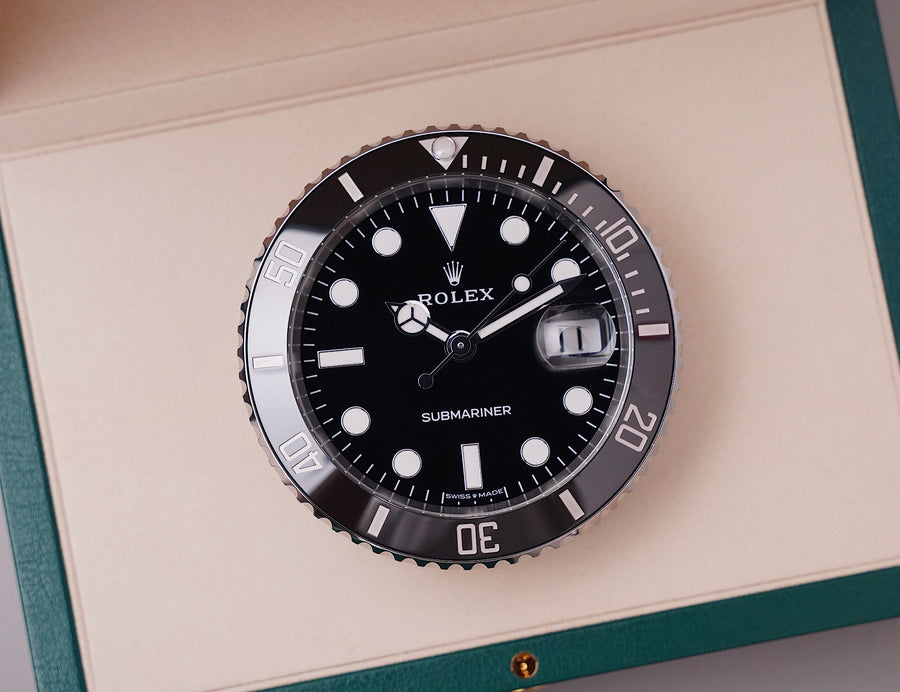


Rolex GMT-Master
In 1955, Pan American World Airways approached Rolex with a unique challenge: create a watch that could display two time zones simultaneously for their pilots flying intercontinental routes. The result was the GMT-Master, a timepiece that would revolutionize travel watches forever. With its sign...
See moreIn 1955, Pan American World Airways approached Rolex with a unique challenge: create a watch that could display two time zones simultaneously for their pilots flying intercontinental routes. The result was the GMT-Master, a timepiece that would revolutionize travel watches forever. With its signature 24-hour rotating bezel and additional GMT hand, pilots could track both local time and Greenwich Mean Time at a glance essential for navigating across time zones.
Today, the GMT-Master II is celebrated not just for its functionality, but for its unmistakable style. The colorful bezels have earned legendary nicknames: the "Pepsi" with its red and blue, the "Batman" in blue and black, the "Coke" in red and black, and the "Root Beer" in brown and gold. Each combination tells a story, and each has its devoted following among collectors. Whether you're a frequent flyer tracking home and destination times, or a watch enthusiast drawn to these iconic designs, the GMT-Master represents Rolex's perfect fusion of form and function.
At Konesseur, we've assembled a curated selection of authentic Rolex GMT-Master and GMT-Master II watches for Dubai's cosmopolitan collectors. Explore our collection below.
5 products
Sort by

Rolex
Rolex GMT-Master II 40 "Pepsi" Ref. 126710BLRO | Jubilee Bracelet black
95,000.00 AED

Rolex
Rolex GMT-Master II Carbon Black Dial
79,000.00 AED

Rolex
Rolex GMT-Master II 40 "Bruce Wayne" Ref. 126710GRNR | Jubilee Bracelet
82,000.00 AED

Rolex
Rolex GMT-Master II 40 "Sprite" Ref. 126720VTNR | Jubilee Bracelet
65,000.00 AED

Rolex
Rolex GMT-Master II 40 "Root Beer" Ref. 126711CHNR
68,000.00 AED
The Rolex GMT-Master: Born in the Golden Age of Aviation
The story of the GMT-Master begins in the mid-1950s, during aviation's golden age. Pan Am's international routes were expanding rapidly, and their pilots needed a reliable way to track multiple time zones. Rolex answered the call in 1955 with the GMT-Master ref. 6542 a watch that could simultaneously display local time and Greenwich Mean Time (GMT), the international standard for aviation.
The innovation was elegant: a fourth hand completing one rotation every 24 hours, paired with a bidirectional rotating bezel marked with 24-hour graduations. Pilots could set the GMT hand to home time and use the rotating bezel to track a third time zone if needed. This wasn't just clever design it was a practical tool that made long-haul flying safer and more efficient.
GMT-Master vs GMT-Master II: Understanding the Difference
In 1982, Rolex introduced the GMT-Master II with a crucial upgrade: an independently adjustable hour hand. This seemingly small change transformed how the watch functions. With the original GMT-Master, adjusting time zones required moving the GMT hand along with the hour hand. The GMT-Master II allows you to "jump" the hour hand forward or backward in one-hour increments while the GMT hand continues tracking home time perfect for travelers crossing time zones.
The GMT-Master II also features a bidirectional rotating bezel, enabling tracking of three time zones simultaneously. Today, Rolex produces only the GMT-Master II, though vintage GMT-Master references remain highly collectible. When collectors and enthusiasts say "GMT-Master," they're often referring to both models the name has become synonymous with Rolex's dual-time complication.
The Iconic Bezel Colorways
The "Pepsi" GMT-Master II
The most iconic GMT-Master features a red and blue Cerachrom ceramic bezel affectionately nicknamed the "Pepsi" for its resemblance to the soda brand's colors. The red represents daytime hours (6 AM to 6 PM) while blue indicates nighttime (6 PM to 6 AM), allowing instant day/night differentiation in your second time zone. Originally produced with aluminum bezels from 1955, the modern Pepsi GMT-Master II (ref. 126710BLRO) features a virtually scratch-proof ceramic bezel. Available on both Oyster and Jubilee bracelets, the Pepsi remains the quintessential GMT-Master.
The "Batman" GMT-Master II
Introduced in 2013, the blue and black bezel GMT-Master II earned the nickname "Batman" for its dark, sophisticated color scheme. The black and blue Cerachrom bezel proved technically challenging to manufacture creating two colors on a single ceramic piece required years of development. The Batman (ref. 116710BLNR and later 126710BLNR) offers a more understated alternative to the Pepsi while maintaining that distinctive two-tone aesthetic. It's become a favorite among collectors who want GMT functionality with slightly more subtle styling.
The "Coke" GMT-Master
The red and black bezel configuration, called the "Coke," offers a bolder, more dramatic look than the Pepsi. While Rolex currently doesn't produce a ceramic Coke bezel, vintage aluminum bezel GMT-Masters in this colorway are highly prized by collectors. The strong contrast between red and black provides excellent legibility while maintaining the GMT-Master's sporty character.
The "Root Beer" GMT-Master
For those seeking elegance, the brown and gold bezel GMT-Master, nicknamed "Root Beer," represents luxury travel at its finest. Typically paired with Rolesor (Rolex's combination of steel and gold) or full gold cases, the Root Beer GMT-Master bridges the gap between tool watch and dress watch. The warm tones work exceptionally well in formal settings while retaining full GMT functionality.
Other GMT-Master Variants
Beyond these famous nicknames, Rolex offers the GMT-Master II in all-black ceramic bezels, blue and red variants, and limited edition models. Recent releases include versions with meteorite dials and even bezels crafted from tiger's eye stone, demonstrating Rolex's continued innovation within this iconic collection.
How the GMT-Master II Works
Reading Two Time Zones
The GMT-Master II displays time in an elegant, intuitive way. The standard hour and minute hands show local time—whatever time zone you're currently in. The red-tipped GMT hand (completing one full rotation every 24 hours) can be set to home time or any second time zone. The 24-hour bezel allows you to track a third time zone by rotating it to align with the GMT hand.
Adjusting Time Zones
When you land in a new time zone, simply pull the crown to the first position and jump the hour hand forward or backward in one-hour increments. The GMT hand continues tracking your home time without interruption. The date changes automatically with the local time display. This quick-set feature makes the GMT-Master II exceptionally practical for frequent travelers—no need to stop the watch or reset anything except the hour hand.
The Movement: Caliber 3285 and 3186
Modern GMT-Master II watches house Rolex's Caliber 3285 (in newer references) or 3186 (in earlier models). These automatic movements feature the innovative GMT module that allows independent hour hand adjustment. With 70 hours of power reserve (3285) or 50 hours (3186), Rolex's Superlative Chronometer certification, and the Parachrom hairspring for superior shock and magnetic resistance, these movements represent the pinnacle of dual-time watchmaking.
The movements are also equipped with Rolex's Chronergy escapement, improving efficiency by approximately 15% compared to traditional escapements. This translates to better timekeeping and extended power reserve—practical benefits that matter in daily wear.
GMT-Master Buying Guide
Which GMT-Master II Should You Choose?
For Classic Appeal: The Pepsi bezel on Jubilee bracelet (ref. 126710BLRO) is the most iconic configuration instantly recognizable and historically significant.
For Versatility: The Batman (blue and black) offers a more subtle colorway that works equally well with suits or casual wear.
For Modern Styling: The all-black bezel GMT-Master II provides sleek, contemporary aesthetics while maintaining full functionality.
For Investment: Steel Pepsi and Batman references have historically shown strong value retention due to their iconic status and limited production.
Sizing and Wearability
The GMT-Master II measures 40mm in diameter with a thickness of approximately 12mm slightly slimmer than the Submariner. This sizing makes it comfortable for all-day wear and suitable for most wrist sizes. The watch slides easily under shirt cuffs, making it appropriate for business travel and formal occasions. Water resistance to 100 meters ensures durability in daily situations, though it's not designed for diving like the Submariner.
Bracelet Options: Oyster vs Jubilee
Recent GMT-Master II models offer a choice between the sporty three-link Oyster bracelet and the more refined five-link Jubilee bracelet. The Oyster provides a tool-watch aesthetic with its brushed links and solid feel. The Jubilee, originally designed for the Datejust, offers greater flexibility and a dressier appearance. Both feature Rolex's Easylink extension system for quick size adjustmentsparticularly useful when traveling between different climates.
GMT-Master in the Rolex Family
Within Rolex's sports watch collection, the GMT-Master II occupies a unique position. While the Submariner is the ultimate dive watch and the Daytona is the iconic chronograph, the GMT-Master II is the traveler's watch. It shares the same robust Oyster case architecture as its siblings but adds the practical complication of dual-time display.
For those seeking other travel-focused Rolex watches, consider the Sky-Dweller, which offers an annual calendar alongside dual-time functionality—though at a higher price point and in a larger 42mm case. The GMT-Master II remains the most versatile and historically significant travel watch in the Rolex catalog.
Collecting GMT-Master Watches
Vintage GMT-Master Models
Vintage GMT-Master references from the 1950s through 1980s are highly sought after by collectors. The earliest ref. 6542 featured a Bakelite bezel and radium lume distinctive features that command premium prices today. The "gilt dial" GMT-Masters from the 1960s, with their golden text on black dials, are particularly coveted. Original Pepsi bezels in good condition have become increasingly rare, driving up values for well-preserved examples.
Investment Considerations
Steel GMT-Master II models, particularly the Pepsi and Batman configurations, have shown strong value retention and appreciation. Limited production relative to demand keeps these models trading above retail prices in the secondary market. Condition, completeness (box and papers), and originality significantly impact value a full set with original purchase documentation commands premium pricing.
The GMT-Master in Dubai
Dubai's position as a global travel hub makes the GMT-Master II particularly relevant for the city's international community. Whether you're a business executive traveling between Dubai and London, a pilot flying intercontinental routes, or simply someone who appreciates functional luxury, the GMT-Master speaks to Dubai's cosmopolitan character. At Konesseur, we serve collectors and professionals who demand both precision timekeeping and unmistakable style.
Frequently Asked Questions
What's the difference between GMT-Master and GMT-Master II?
The GMT-Master II (introduced 1982) features an independently adjustable hour hand, allowing you to change time zones by simply jumping the hour hand forward or backward without affecting the GMT hand or stopping the watch. The original GMT-Master required adjusting both hands together. The GMT-Master II is more practical for frequent travelers. Rolex currently produces only GMT-Master II models, though both are commonly called "GMT-Master."
Why is the Pepsi GMT-Master so popular?
The Pepsi (red and blue bezel) is the original and most iconic GMT-Master colorway, dating back to 1955. Its historical significance, Pan Am aviation heritage, and distinctive appearance make it the most recognizable GMT-Master configuration. The contrast between red and blue provides excellent day/night readability. Combined with limited production and high demand, the Pepsi consistently commands premium pricing in the secondary market.
Can the GMT-Master track three time zones?
Yes. The GMT-Master II can track three time zones simultaneously: (1) local time via the main hour and minute hands, (2) home/reference time via the red GMT hand reading against the 24-hour bezel, and (3) a third time zone by rotating the bezel to align with the GMT hand. This makes it exceptionally practical for international business travelers managing multiple markets.
Is the GMT-Master waterproof?
The GMT-Master II is water-resistant to 100 meters (330 feet). While not a dive watch like the Submariner (300m) or Sea-Dweller (1,220m), 100m water resistance is more than adequate for daily wear, swimming, and showering. The Triplock crown system ensures reliable water protection.
Which GMT-Master holds its value best?
Stainless steel GMT-Master II models in Pepsi and Batman configurations have historically shown the strongest value retention and appreciation. The ceramic bezel versions (ref. 126710BLRO and 126710BLNR) benefit from modern materials and movements while maintaining iconic designs. Vintage GMT-Masters with original components and documentation also command strong prices in the collector market.
Should I choose Oyster or Jubilee bracelet?
This is largely personal preference. The Oyster bracelet (three-link) offers a sportier, more robust appearance preferred by those who see the GMT-Master II primarily as a tool watch. The Jubilee (five-link) provides a dressier, more flexible feel that some find more comfortable for all-day wear. The Pepsi bezel is available on both; try each to determine your preference. Both bracelets feature Rolex's Easylink extension for quick adjustment.
Rolex GMT-Master
The Rolex GMT-Master: Born in the Golden Age of Aviation
The story of the GMT-Master begins in the mid-1950s, during aviation's golden age. Pan Am's international routes were expanding rapidly, and their pilots needed a reliable way to track multiple time zones. Rolex answered the call in 1955 with the GMT-Master ref. 6542 a watch that could simultaneously display local time and Greenwich Mean Time (GMT), the international standard for aviation.
The innovation was elegant: a fourth hand completing one rotation every 24 hours, paired with a bidirectional rotating bezel marked with 24-hour graduations. Pilots could set the GMT hand to home time and use the rotating bezel to track a third time zone if needed. This wasn't just clever design it was a practical tool that made long-haul flying safer and more efficient.
GMT-Master vs GMT-Master II: Understanding the Difference
In 1982, Rolex introduced the GMT-Master II with a crucial upgrade: an independently adjustable hour hand. This seemingly small change transformed how the watch functions. With the original GMT-Master, adjusting time zones required moving the GMT hand along with the hour hand. The GMT-Master II allows you to "jump" the hour hand forward or backward in one-hour increments while the GMT hand continues tracking home time perfect for travelers crossing time zones.
The GMT-Master II also features a bidirectional rotating bezel, enabling tracking of three time zones simultaneously. Today, Rolex produces only the GMT-Master II, though vintage GMT-Master references remain highly collectible. When collectors and enthusiasts say "GMT-Master," they're often referring to both models the name has become synonymous with Rolex's dual-time complication.
The Iconic Bezel Colorways
The "Pepsi" GMT-Master II
The most iconic GMT-Master features a red and blue Cerachrom ceramic bezel affectionately nicknamed the "Pepsi" for its resemblance to the soda brand's colors. The red represents daytime hours (6 AM to 6 PM) while blue indicates nighttime (6 PM to 6 AM), allowing instant day/night differentiation in your second time zone. Originally produced with aluminum bezels from 1955, the modern Pepsi GMT-Master II (ref. 126710BLRO) features a virtually scratch-proof ceramic bezel. Available on both Oyster and Jubilee bracelets, the Pepsi remains the quintessential GMT-Master.
The "Batman" GMT-Master II
Introduced in 2013, the blue and black bezel GMT-Master II earned the nickname "Batman" for its dark, sophisticated color scheme. The black and blue Cerachrom bezel proved technically challenging to manufacture creating two colors on a single ceramic piece required years of development. The Batman (ref. 116710BLNR and later 126710BLNR) offers a more understated alternative to the Pepsi while maintaining that distinctive two-tone aesthetic. It's become a favorite among collectors who want GMT functionality with slightly more subtle styling.
The "Coke" GMT-Master
The red and black bezel configuration, called the "Coke," offers a bolder, more dramatic look than the Pepsi. While Rolex currently doesn't produce a ceramic Coke bezel, vintage aluminum bezel GMT-Masters in this colorway are highly prized by collectors. The strong contrast between red and black provides excellent legibility while maintaining the GMT-Master's sporty character.
The "Root Beer" GMT-Master
For those seeking elegance, the brown and gold bezel GMT-Master, nicknamed "Root Beer," represents luxury travel at its finest. Typically paired with Rolesor (Rolex's combination of steel and gold) or full gold cases, the Root Beer GMT-Master bridges the gap between tool watch and dress watch. The warm tones work exceptionally well in formal settings while retaining full GMT functionality.
Other GMT-Master Variants
Beyond these famous nicknames, Rolex offers the GMT-Master II in all-black ceramic bezels, blue and red variants, and limited edition models. Recent releases include versions with meteorite dials and even bezels crafted from tiger's eye stone, demonstrating Rolex's continued innovation within this iconic collection.
How the GMT-Master II Works
Reading Two Time Zones
The GMT-Master II displays time in an elegant, intuitive way. The standard hour and minute hands show local time—whatever time zone you're currently in. The red-tipped GMT hand (completing one full rotation every 24 hours) can be set to home time or any second time zone. The 24-hour bezel allows you to track a third time zone by rotating it to align with the GMT hand.
Adjusting Time Zones
When you land in a new time zone, simply pull the crown to the first position and jump the hour hand forward or backward in one-hour increments. The GMT hand continues tracking your home time without interruption. The date changes automatically with the local time display. This quick-set feature makes the GMT-Master II exceptionally practical for frequent travelers—no need to stop the watch or reset anything except the hour hand.
The Movement: Caliber 3285 and 3186
Modern GMT-Master II watches house Rolex's Caliber 3285 (in newer references) or 3186 (in earlier models). These automatic movements feature the innovative GMT module that allows independent hour hand adjustment. With 70 hours of power reserve (3285) or 50 hours (3186), Rolex's Superlative Chronometer certification, and the Parachrom hairspring for superior shock and magnetic resistance, these movements represent the pinnacle of dual-time watchmaking.
The movements are also equipped with Rolex's Chronergy escapement, improving efficiency by approximately 15% compared to traditional escapements. This translates to better timekeeping and extended power reserve—practical benefits that matter in daily wear.
GMT-Master Buying Guide
Which GMT-Master II Should You Choose?
For Classic Appeal: The Pepsi bezel on Jubilee bracelet (ref. 126710BLRO) is the most iconic configuration instantly recognizable and historically significant.
For Versatility: The Batman (blue and black) offers a more subtle colorway that works equally well with suits or casual wear.
For Modern Styling: The all-black bezel GMT-Master II provides sleek, contemporary aesthetics while maintaining full functionality.
For Investment: Steel Pepsi and Batman references have historically shown strong value retention due to their iconic status and limited production.
Sizing and Wearability
The GMT-Master II measures 40mm in diameter with a thickness of approximately 12mm slightly slimmer than the Submariner. This sizing makes it comfortable for all-day wear and suitable for most wrist sizes. The watch slides easily under shirt cuffs, making it appropriate for business travel and formal occasions. Water resistance to 100 meters ensures durability in daily situations, though it's not designed for diving like the Submariner.
Bracelet Options: Oyster vs Jubilee
Recent GMT-Master II models offer a choice between the sporty three-link Oyster bracelet and the more refined five-link Jubilee bracelet. The Oyster provides a tool-watch aesthetic with its brushed links and solid feel. The Jubilee, originally designed for the Datejust, offers greater flexibility and a dressier appearance. Both feature Rolex's Easylink extension system for quick size adjustmentsparticularly useful when traveling between different climates.
GMT-Master in the Rolex Family
Within Rolex's sports watch collection, the GMT-Master II occupies a unique position. While the Submariner is the ultimate dive watch and the Daytona is the iconic chronograph, the GMT-Master II is the traveler's watch. It shares the same robust Oyster case architecture as its siblings but adds the practical complication of dual-time display.
For those seeking other travel-focused Rolex watches, consider the Sky-Dweller, which offers an annual calendar alongside dual-time functionality—though at a higher price point and in a larger 42mm case. The GMT-Master II remains the most versatile and historically significant travel watch in the Rolex catalog.
Collecting GMT-Master Watches
Vintage GMT-Master Models
Vintage GMT-Master references from the 1950s through 1980s are highly sought after by collectors. The earliest ref. 6542 featured a Bakelite bezel and radium lume distinctive features that command premium prices today. The "gilt dial" GMT-Masters from the 1960s, with their golden text on black dials, are particularly coveted. Original Pepsi bezels in good condition have become increasingly rare, driving up values for well-preserved examples.
Investment Considerations
Steel GMT-Master II models, particularly the Pepsi and Batman configurations, have shown strong value retention and appreciation. Limited production relative to demand keeps these models trading above retail prices in the secondary market. Condition, completeness (box and papers), and originality significantly impact value a full set with original purchase documentation commands premium pricing.
The GMT-Master in Dubai
Dubai's position as a global travel hub makes the GMT-Master II particularly relevant for the city's international community. Whether you're a business executive traveling between Dubai and London, a pilot flying intercontinental routes, or simply someone who appreciates functional luxury, the GMT-Master speaks to Dubai's cosmopolitan character. At Konesseur, we serve collectors and professionals who demand both precision timekeeping and unmistakable style.
Frequently Asked Questions
What's the difference between GMT-Master and GMT-Master II?
The GMT-Master II (introduced 1982) features an independently adjustable hour hand, allowing you to change time zones by simply jumping the hour hand forward or backward without affecting the GMT hand or stopping the watch. The original GMT-Master required adjusting both hands together. The GMT-Master II is more practical for frequent travelers. Rolex currently produces only GMT-Master II models, though both are commonly called "GMT-Master."
Why is the Pepsi GMT-Master so popular?
The Pepsi (red and blue bezel) is the original and most iconic GMT-Master colorway, dating back to 1955. Its historical significance, Pan Am aviation heritage, and distinctive appearance make it the most recognizable GMT-Master configuration. The contrast between red and blue provides excellent day/night readability. Combined with limited production and high demand, the Pepsi consistently commands premium pricing in the secondary market.
Can the GMT-Master track three time zones?
Yes. The GMT-Master II can track three time zones simultaneously: (1) local time via the main hour and minute hands, (2) home/reference time via the red GMT hand reading against the 24-hour bezel, and (3) a third time zone by rotating the bezel to align with the GMT hand. This makes it exceptionally practical for international business travelers managing multiple markets.
Is the GMT-Master waterproof?
The GMT-Master II is water-resistant to 100 meters (330 feet). While not a dive watch like the Submariner (300m) or Sea-Dweller (1,220m), 100m water resistance is more than adequate for daily wear, swimming, and showering. The Triplock crown system ensures reliable water protection.
Which GMT-Master holds its value best?
Stainless steel GMT-Master II models in Pepsi and Batman configurations have historically shown the strongest value retention and appreciation. The ceramic bezel versions (ref. 126710BLRO and 126710BLNR) benefit from modern materials and movements while maintaining iconic designs. Vintage GMT-Masters with original components and documentation also command strong prices in the collector market.
Should I choose Oyster or Jubilee bracelet?
This is largely personal preference. The Oyster bracelet (three-link) offers a sportier, more robust appearance preferred by those who see the GMT-Master II primarily as a tool watch. The Jubilee (five-link) provides a dressier, more flexible feel that some find more comfortable for all-day wear. The Pepsi bezel is available on both; try each to determine your preference. Both bracelets feature Rolex's Easylink extension for quick adjustment.