


Ap Royal Oak buying guide 2026
The Audemars Piguet Royal Oak is the watch that invented a category. Before April 15, 1972, the idea of a luxury sports watch made from stainless steel did not exist. After that date, it was the only idea that mattered. Gerald Genta sketched the original on a single evening, the octagonal bezel with eight visible screws became the most recognisable silhouette in watchmaking, and more than 500 iterations later the Royal Oak remains the centrepiece of everything Audemars Piguet does.
If you are considering buying one in 2026, you are entering a collection that spans quartz models at around $20,000 to grand complications approaching seven figures. The range is enormous. The differences between references matter. And the secondary market adds another layer of pricing that does not always follow retail logic. This guide covers every current model family, what each one costs at retail and on the open market, and which Royal Oak actually makes sense for different buyers.
If you are exploring the broader Audemars Piguet collection at Konesseur, this is the model that defines the brand.
Why the Royal Oak Matters: The Genta Story
In the early 1970s, the Swiss watch industry was in crisis. Japanese quartz movements were faster, cheaper, and more accurate than anything coming out of the Vallée de Joux. Audemars Piguet needed something radical. They turned to Gerald Genta, a designer who had already created the Universal Genève Polerouter, and asked him for a steel sports watch that could be sold at gold watch prices.
Genta delivered the design overnight. He drew inspiration from a traditional diving helmet, the kind with a porthole secured by bolts around its perimeter. That became the octagonal bezel with eight hexagonal screws, visible and functional, holding the bezel to the case. The integrated bracelet flowed seamlessly from the case, a detail that was genuinely new in 1972. The tapisserie dial, with its waffle pattern catching light at every angle, gave the watch texture and depth that a flat dial could never achieve.
The debut model, reference 5402ST, was nicknamed the "Jumbo" because its 39mm case was considered large for the era. It was 7mm thin, powered by the ultra slim Calibre 2121, and it cost 3,300 Swiss Francs. That was roughly four times the price of a Rolex Submariner. The market did not know what to make of it at first. Then it understood.
More than fifty years later, that original price ratio between a Royal Oak and a Submariner still holds. The design language has not changed. The octagon, the screws, the tapisserie, the integrated bracelet. Everything Genta drew that night in 1972 is still on your wrist in 2026.
The Royal Oak Families: Understanding What You Are Buying
The Royal Oak is not one watch. It is an ecosystem of references that share the same design DNA but serve completely different purposes. Understanding the families before you look at prices will save you from buying the wrong one.
The Jumbo Extra Thin (Reference 16202)
This is the purist's Royal Oak. The 16202 replaced the legendary 15202 in 2022 as part of the 50th anniversary, and it stays closest to what Genta originally designed. The case is 39mm and just 8.1mm thin. There is no seconds hand, only hours, minutes, and a date window. The Petite Tapisserie dial is the classic pattern. It looks and feels like the original, because that is exactly the point.
The major technical upgrade is the Calibre 7121, which Audemars Piguet spent five years developing. It delivers 55 hours of power reserve compared to the old movement's 40 hours, introduces quick set date functionality, and runs at a modern 28,800 vibrations per hour for improved accuracy. The 50th anniversary production models carry a commemorative rotor, adding a small but meaningful collectibility layer.
The 16202ST in stainless steel lists for approximately $40,100 at retail. On the secondary market, pristine examples are trading between $70,000 and $85,000. Rose gold variants approach six figures. Annual production is estimated at 3,000 to 4,000 pieces, far fewer than the standard Selfwinding models, which helps explain the sustained premium.
This is the Royal Oak for someone who values historical significance, thinness on the wrist, and the closest possible connection to the 1972 original. It is not for someone who wants a seconds hand or a larger case.
The Selfwinding 41mm (Reference 15510)
If the Jumbo is the connoisseur's choice, the 15510 is the practical one. It replaced the 15500 in 2022, measures 41mm with a 10.4mm thickness, and houses the Calibre 4302 with a 70 hour power reserve. It has a central seconds hand, which the Jumbo does not. It is the Royal Oak most people will actually buy, and for good reason.
The 15510 comes in stainless steel, rose gold, and various dial colours including blue, black, green, grey, and white. At retail, the steel 15510ST starts around $33,900, though availability through boutiques is limited and waitlists are standard. On the secondary market, the steel blue dial 15510ST trades at approximately $55,000 to $65,000, representing a significant premium over retail that reflects how difficult it is to acquire one through normal channels.
Secondary market performance has been strong. The 15510ST appreciated 17.1% over the past year, outperforming both the broader Audemars Piguet index and the overall luxury watch market. It consistently ranks in the top 2% of all Audemars Piguet models by trading volume, with roughly 79 recorded sales in January 2026 alone.
This is the Royal Oak for someone who wants the full modern package. Readable size, central seconds, excellent power reserve, and a watch that works equally well with a suit or a t shirt.
The Chronograph
The Royal Oak Chronograph adds stopwatch functionality through two subdials and raises the thickness and presence considerably. Steel chronographs start at approximately $39,200 at retail, with precious metal versions exceeding $100,000. In 2026, Audemars Piguet introduced a new 38mm chronograph (reference 26450) in both steel and rose gold, offering a slightly smaller alternative to the existing 41mm chronograph models.
The chronograph is the Royal Oak for buyers who want complication and visual complexity. The two registers on the dial give it a busier appearance than the time only models, and the additional pushers on the case add tactile interest. It is a statement piece that leans sporty.
The Perpetual Calendar
This is where the Royal Oak crosses from luxury sports watch into haute horlogerie. The perpetual calendar automatically tracks the date, day, month, and leap year cycle, requiring no manual correction until the year 2100. Steel perpetual calendar models start around $110,900, with gold versions exceeding $300,000.
For 2026, Audemars Piguet has introduced an openworked perpetual calendar with the new Calibre 7139, featuring an innovative single crown setting system that makes adjusting the calendar significantly simpler than previous generations. The titanium and BMG bezel combination gives it a distinctly modern aesthetic.
This is the Royal Oak for serious collectors who want mechanical complexity alongside the iconic design. It requires commitment, both financial and intellectual, to appreciate fully.
The Royal Oak Offshore
Emmanuel Gueit designed the Offshore in 1993 as a larger, bolder interpretation of the Royal Oak. It was immediately nicknamed "The Beast" and it earned it. The Offshore typically measures 42mm to 44mm, features the Mega Tapisserie dial pattern rather than the Petite Tapisserie, and leans heavily into sport and adventure aesthetics. The most popular reference, the 15710ST diver, has an estimated market value around $18,500.
The Offshore occupies a different space from the core Royal Oak. It is louder, more casual, and appeals to buyers who want presence above refinement. Average Offshore prices sit around $27,000 compared to the Royal Oak proper at $46,000, making it a more accessible entry point into the Audemars Piguet world.
2026 Pricing: Retail vs Secondary Market
Understanding the gap between what Audemars Piguet charges at the boutique and what the market actually demands is essential before buying.
For the Jumbo 16202ST, retail sits at approximately $40,100. The secondary market demands $70,000 to $85,000 for pristine examples. That is roughly a 75% to 110% premium, which reflects both limited production and the historical weight of owning a Jumbo.
The Selfwinding 15510ST retails at approximately $33,900. Secondary market pricing runs $55,000 to $65,000. The premium is lower than the Jumbo but still substantial, and the much higher trading volume makes it easier to find the configuration you want.
Rose gold models across both families command premiums of two to three times their steel counterparts. A rose gold Selfwinding starts around $48,000 at retail with market prices exceeding $80,000. Titanium and ceramic models fall between steel and gold in terms of both retail and secondary pricing.
For Dubai buyers, the pricing conversation has an additional dimension. The UAE's 5% VAT compares favourably to the 20% VAT charged across much of Europe, which means purchasing a Royal Oak through a Dubai based retailer like Konesseur can represent meaningful savings compared to European boutiques, particularly on higher value precious metal references where the absolute tax difference runs into thousands of dirhams.
Dial Colours: What Sells and What Holds
The blue dial Royal Oak is the definitive version. From the original 5402 through to the current 16202 and 15510, the blue tapisserie dial has been the most requested, most photographed, and strongest performing colour on the secondary market. If you are buying one Royal Oak and want the safest long term choice, blue is it.
Black and grey dials offer a more understated alternative and tend to sit slightly below blue in secondary market pricing, though the gap is narrower than many buyers expect. White dials have gained momentum in recent years, particularly among collectors who already own a blue and want contrast in their rotation.
Green entered the Royal Oak palette recently and has drawn significant collector interest. The 2026 lineup includes new malachite stone dial models in both 37mm and 41mm yellow gold cases, a material choice that gives each dial a unique natural pattern. These are niche pieces with limited production that could develop strong secondary market premiums.
The general rule is that classic dial colours in steel cases deliver the most predictable value retention. Exotic combinations in precious metals are more volatile but can produce exceptional returns if they capture collector sentiment.
Royal Oak vs the Competition
Royal Oak vs Patek Philippe Nautilus
This is the comparison that defines the luxury sports watch category. Both were born in the 1970s, both were designed by Gerald Genta, and both share the integrated bracelet concept. The differences are in character.
The Royal Oak is more visually assertive. The octagonal bezel and exposed screws are declarations, not whispers. The Patek Philippe Nautilus is more restrained, with softer curves and a porthole design that reads quieter on the wrist. From a pricing perspective, the Nautilus 5811/1G in white gold starts at approximately $89,767 at retail and trades even higher, placing it well above the steel Royal Oak Jumbo in absolute terms.
The investment argument is nuanced. Patek Philippe's production discipline and global collector demand have historically produced stronger secondary market trajectories. However, the Royal Oak offers a wider range of entry points and complications at lower price levels, and recent appreciation rates for key references like the 15510ST have been compelling.
For many collectors, the answer is eventually both. The Royal Oak for presence, the Nautilus for restraint. They complete different roles rather than competing for the same one.
Royal Oak vs Vacheron Constantin Overseas
The Vacheron Constantin Overseas is the third member of the luxury sports watch trinity. It offers a travel time complication, interchangeable straps (including a rubber option that the Royal Oak lacks), and comes from a brand with even longer heritage than either AP or Patek. It is also more available at retail and carries lower secondary market premiums, making it arguably better value as a pure watch purchase. However, it does not carry the same cultural cachet or investment trajectory as the Royal Oak.
Royal Oak vs Rolex
Different categories. A Rolex Submariner or GMT Master sits at roughly a quarter of the Royal Oak's price point and serves a more tool oriented purpose. Many collectors start with Rolex and graduate to AP or Patek as their collection matures. The Royal Oak is not about diving bezels or pilot functions. It is about wearing something that represents the pinnacle of luxury sports watchmaking design, and paying accordingly.
What to Look for When Buying Pre Owned
The Royal Oak bracelet is one of the most complex integrated bracelets in watchmaking, and it is also one of the most vulnerable to wear. Check for stretch in the links, which manifests as visible gaps between segments when the bracelet hangs freely. A bracelet replacement from Audemars Piguet can cost several thousand dollars and requires returning the watch to the manufacture.
Verify the bezel screws. They should sit perfectly flush with the bezel surface, with clean hex recesses and no evidence of incorrect tool use. Stripped or damaged screws are a sign of amateur servicing and can significantly reduce value.
Service history matters more for the Royal Oak than for many other luxury watches. Audemars Piguet recommends service every five to eight years, with full services running $1,500 to $3,000 depending on the complication. A documented service history from Audemars Piguet adds value at resale, while a watch with no service records raises questions about its mechanical condition.
The tapisserie dial should be examined carefully under good lighting. Any refinishing or damage to the guilloche pattern is extremely difficult to repair and effectively permanent. Original, unpolished cases command premiums over pieces that have been polished, as the hand finished brushing and polishing on a Royal Oak case requires specific expertise to maintain correctly.
Complete sets with original box, papers, certificate of origin, and purchase receipt consistently sell for 10% to 15% more than watch only sales. For any pre owned Royal Oak purchase, authentication by a specialist is essential. Konesseur authenticates every piece before it enters the collection, verifying reference numbers, movement condition, bracelet integrity, and dial originality.
The 2026 Novelties Worth Knowing About
Audemars Piguet entered 2026 with several notable additions to the Royal Oak family. The openworked perpetual calendar with the new Calibre 7139 in titanium with a BMG bezel represents a technical leap, featuring a single crown that sets the entire perpetual calendar display. The malachite stone dial models in yellow gold bring natural material experimentation to the collection. A new Bleu Nuit Nuage 50 ceramic perpetual calendar extends the ceramic material story. And the Jumbo Extra Thin has been released in a titanium openworked configuration.
For buyers focused on core models, the steel 16202 Jumbo and 15510 Selfwinding remain the most relevant references. The novelties are for collectors who already own the fundamentals and want something distinctive.
Caring for Your Royal Oak
The integrated bracelet collects dust, skin cells, and product residue in its links. Regular cleaning with a soft brush and lukewarm water keeps the bracelet looking its best between services. Avoid ultrasonic cleaners unless recommended by Audemars Piguet.
Store your Royal Oak away from magnets, which can affect the movement's accuracy. A quality watch box or pouch protects the case and bracelet from contact with other objects. If you own an automatic reference and do not wear it daily, a watch winder maintains the power reserve, though this is a matter of personal preference rather than mechanical necessity.
Water resistance ratings on Royal Oak models vary by reference. The standard Selfwinding is rated to 50 metres, which means it handles rain and hand washing but should not be taken swimming. The Offshore Diver models carry higher ratings for genuine water use. Regardless of rating, have water resistance tested after any service or case opening.
Frequently Asked Questions
How much does an Audemars Piguet Royal Oak cost in 2026?
Retail prices start at $19,900 for a 33mm quartz model and rise to $40,100 for the steel Jumbo Extra Thin. On the secondary market, the most popular steel Selfwinding 15510ST trades at approximately $55,000 to $65,000, and the steel Jumbo 16202ST trades between $70,000 and $85,000. Precious metal and complicated versions range well into six figures.
Is the Royal Oak Jumbo worth the premium over the Selfwinding?
The Jumbo commands a significant premium, both at retail and on the secondary market, for two reasons. First, production is far more limited at approximately 3,000 to 4,000 pieces annually versus over 15,000 for the Selfwinding. Second, it is the reference that connects most directly to the 1972 original, which carries cultural and collector value that transcends specification. If historical lineage and thinness on the wrist matter to you, the premium is justified. If you want a central seconds hand and more robust daily wearability, the 15510 is the better watch for your needs.
Is the Audemars Piguet Royal Oak a good investment?
Key references have appreciated meaningfully. The 15510ST rose 17.1% over the past year, outperforming the broader watch market. The discontinued 15202ST has settled at approximately $59,000 on the secondary market against a final retail price of $25,000, representing a 136% premium. However, not every Royal Oak appreciates. Ladies models, certain dial colours, and gold references on leather straps can depreciate from retail. Steel time only models in classic dial colours, particularly blue, have the strongest track record.
What is the difference between the Royal Oak and the Royal Oak Offshore?
The Offshore is larger (typically 42mm to 44mm versus 39mm to 41mm for the core Royal Oak), thicker, and more overtly sporty. It uses a Mega Tapisserie dial pattern instead of the Petite Tapisserie, and features prominent rubber gaskets and pusher guards on chronograph models. Average secondary market pricing for the Offshore sits around $27,000 versus $46,000 for the core Royal Oak, making it a more accessible entry point. The Offshore attracts a different buyer: someone who wants maximum presence and a casual sports aesthetic.
Should I buy a Royal Oak in Dubai?
Dubai offers a competitive advantage for luxury watch purchases. The UAE's 5% VAT is significantly lower than European markets where VAT can reach 20%. For a watch costing AED 150,000 or more, the tax savings alone can amount to several thousand dirhams compared to buying the same piece in Paris, London, or Zurich. Beyond tax, Dubai's luxury market includes specialist retailers like Konesseur that offer authenticated pre owned Royal Oak pieces at competitive secondary market pricing with the assurance of professional verification.
Which Royal Oak size is best for smaller wrists?
The 39mm Jumbo Extra Thin is surprisingly comfortable on wrists as small as 6 inches because its 8.1mm thickness allows it to sit flat rather than protruding. The integrated bracelet also helps the watch conform to the wrist shape. The 37mm Selfwinding models offer a dedicated midsize option. The 41mm Selfwinding works well on most wrists 6.5 inches and above, though the 10.4mm thickness gives it more presence than the Jumbo. Try before you buy whenever possible.
How often does a Royal Oak need servicing?
Audemars Piguet recommends full service every five to eight years. A complete service typically costs $1,500 to $3,000 depending on the complication level. For chronographs and perpetual calendars, expect the higher end of that range. Regular servicing by Audemars Piguet maintains accurate timekeeping, ensures water resistance, and preserves documented history that adds value at resale.
What are the new Royal Oak models for 2026?
Notable 2026 releases include an openworked perpetual calendar with the Calibre 7139 in titanium, malachite stone dial models in 37mm and 41mm yellow gold, a Bleu Nuit Nuage 50 ceramic perpetual calendar, a new 38mm chronograph in steel and rose gold (reference 26450), a Jumbo Extra Thin in titanium openworked, and a Double Balance Wheel Openworked in yellow gold. The core steel references (16202ST and 15510ST) continue unchanged.
 Same Day Delivery
 Same Day Delivery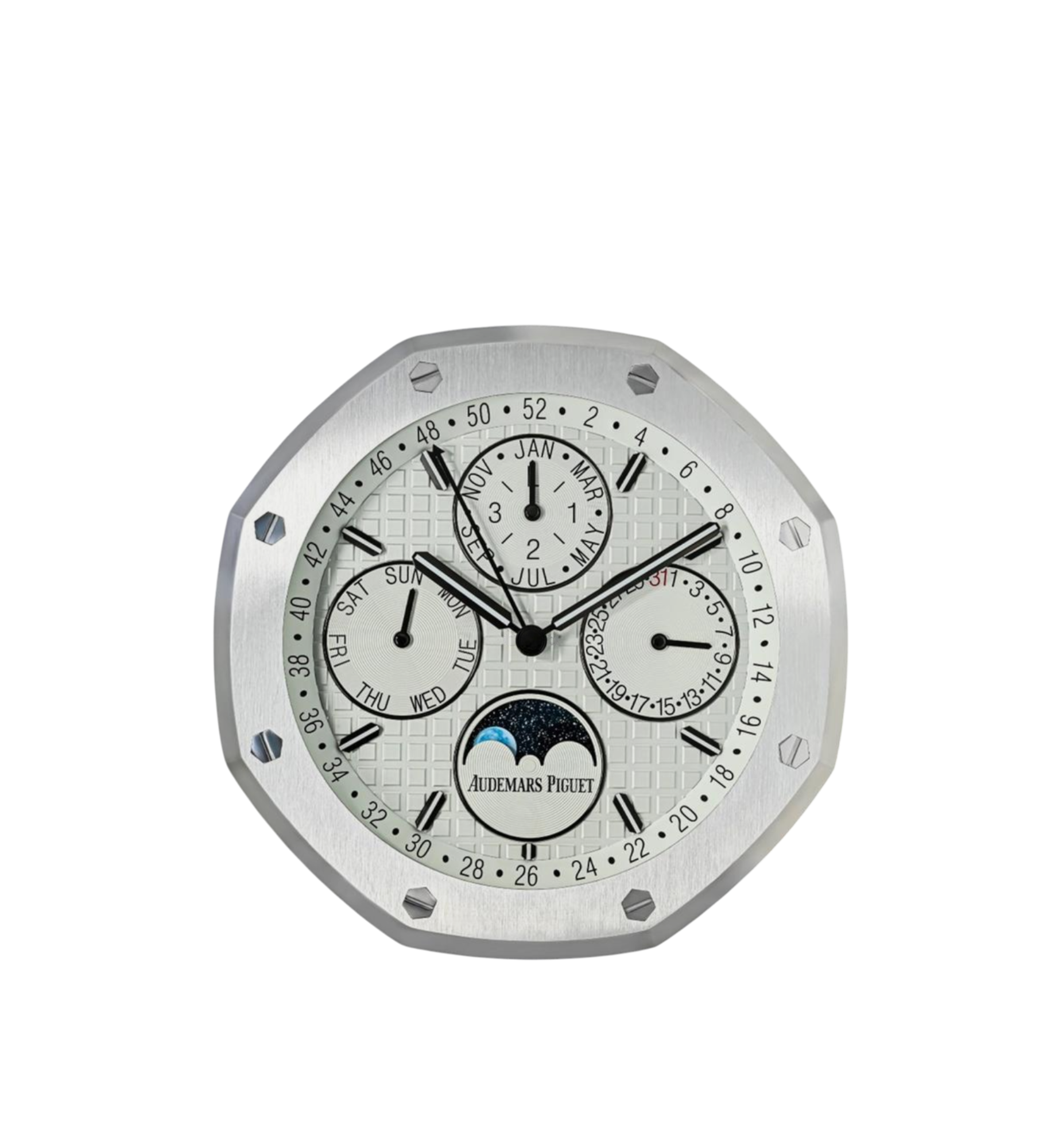







Read more
Cartier is the only luxury brand in the world that is equally famous for its jewellery and its watches. That dual identity is precisely what makes buying a Cartier watch different from buying a Rol...

Franck Muller is one of those brands that inspires a very specific kind of loyalty among collectors. The tonneau case, the oversized Arabic numerals, the mechanical ambition that earned the brand i...